You’ve only got a couple of days, to spend in Malta, so you opt for an apartment close to the airport – or worse, your flight got delayed and you’ve got quite a few hours to kill. Maybe you’re living close to the airport because you’re in Malta for work-related matters. Either way, you’re located on the opposite side of where all the touristy outings and events are, and you’d like to take a peek at what Malta has to offer. While this side of the island may not be over-saturated with ultra-touristic spots, it offers quite a few areas where Maltese character still shines, and will hopefully continue to shine for a long time.
The closest historical site to the Airport –
the Chapel at Bir Miftuħ
This one is really easy to get to, and it is also the closest historical site to Malta’s airport – the Chapel of Santa Marija at Bir MIftuħ is the chapel visible on the left while driving up to the airport, with a very distinctive belfry made up of three arches, This Chapel is one of the oldest on the island, having been built in around 1430, and is dedicated to the Holy Mary. This chapel also houses some incredible frescos from the fifteenth century, which depict a variety of biblical and religious scenes, and which are still preserved in utmost vibrancy. The Chapel is under the guardianship of Malta’s National Trust, Din l-Art Ħelwa, and is open for visitors every first Sunday of the month, from 09:30 to 12:00, or by appointment. If you only have a couple of hours to kill on the Island, then this is a sure must-see. You’ll also be close enough to the Airport to make sure you don’t miss your flight.

Ġnien Sir Alexander Ball –
a quaint garden in Ħal Safi
Back when Malta was freshly under British rule, one very generous Civil Commissioner by the name of Alexander Ball, thought of an ingenious way by which he could promote greenery among Maltese villages. He devised a total of 21 publicly accessible gardens, which could be used by the villagefolk to grow fruits and crops, while also providing a recreational area. Ball committed one grave mistake however, when he gave the guardianship of these gardens to the temporary lieutenants who were responsible for the village. These made the gardens their own, and the name ‘Ġnien tal-Kmand’ or Commander’s Garden stuck. It was through this horticultural experiment that Malta started its now-famous production of potato crops, which quickly took the place of cotton as Malta’s most exported and profitable crop. Most of these gardens have been lost to time, but some remain, and one of the best preserved of these can be found in Ħal Safi, just a few minutes away from the Airport. It’s the perfect place to revel in tranquility, so grab a book and indulge in an hour (or two) of peaceful reading.

For the best views –
Wied Fulija
If time is of the essence, but you would still love to take in some breath-taking views of the surrounding Mediterranean, Wied Fulija is a must-see. This simple park, perched on the top of the cliffs on the Western side of the island, was formerly an unruly dumpster, an eyesore on Malta’s coast. After recent refurbishment, the area has taken on a new lease of life, and a fresh new look. Wied Fulija is a lovely spot for sunset views (although the sun sets further East during summertime) or for a morning jog. The park is also dog-friendly and family friendly, with restroom facilities available, and paved walkways on which children can roam freely.
For some weird history –
Il-Maqluba
The village of Qrendi houses some impressive archaeological remains, and is home to Malta’s most famous prehistoric temples, Ħaġar Qim and Mnajdra. A small distance away from these temples lies a geological phenomenon which stumped the villagers of Qrendi in ancient times, and gave birth to a most creative and fantastical myth about the creation of the sinkhole at il-Maqluba. The word Maqluba in Maltese means inside-out or upside-down, and the sinkhole looks like a huge chunk of land was just scooped out of its surroundings. The Medieval Maltese saw this as a perfect opportunity to create an allegory which would instruct fellow Christians on how to behave, and grow their devotion towards God and their fear from the devil. The myth says that right where the sinkhole is located, stood a village rife with sin, inhabited by people of great vices and immoral ways. A kindly neighbour tried to warn them of their uncouth way of life and maybe entice them to repent. The villagers were relentless, and so fixedly set in their wayward ways, that God himself ordered for the land to be extracted from its surroundings, and to be thrown into the sea, thereby creating the islet of Filfla. The chapel at the edge of the sinkhole, naturally, escpaed this gruesome fate. This site is the farthest from the Airport out of all the sites mentioned here, but it is by far one of the most interesting and intriguing.
The hidden medieval chapels –
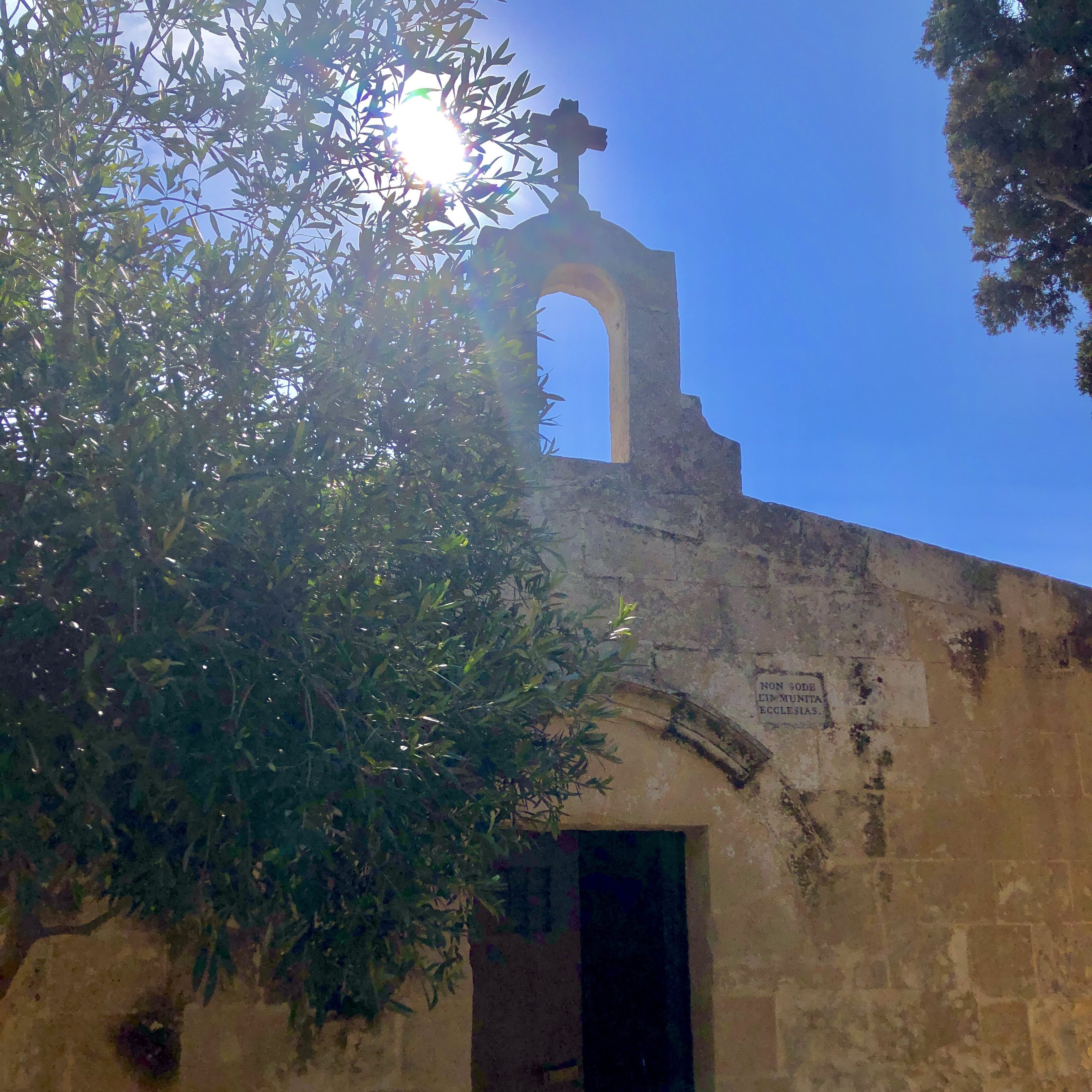
Ħal Millieri, Żurrieq
Ħal Millieri, now merely a remote area off of the much larger village of Żurrieq, was once a bustling Medieval hamlet. This small village, and neighbouring villages around it, eventually formed what is now known as Żurrieq. The hamlet, recorded in the 15th century as Casal Millieri probably dates back to a much older period, and is thought to have been extant as far back as Roman, and even prehistoric, times. Ħal MIllieri is home to two historic chapels, one of which is dedicated to the Annunciation, while the other is named after St John the Evangelist. The latter is the sole remnant of a chain of twelve chapels which existed in the area, and which celebrated a different apostle. The parvis and cross found in front of the Chapel dedicated to St John the Evangelist are original remains of the hamlet’s square, where the villagers met and exchanged ideas. The Chapel dedicated to the Annunciation is beautifully adorned with Medieval frescos, which have survived exquisitely. The frescos cover all the interior walls and depict a variety of saints. Truly a sight to behold, in close proximity to the Airport nonetheless. The Chapel of the Annunciation is open to the public every first Sunday of the month from 09:00 to 12:00.
 Notebook
